Keeping Cash Handling Moving in High-Traffic Locations
How a global travel retail operator improved traceability, reduced time spent on shift handovers, and achieved ROI in just five weeks.
0 Hours
Saved Per Unit, Per Week
0 Weeks
ROI Achieved
0-Location
In-Store Trial
The Story in Brief
Operating restaurants, bars, cafés, and retail outlets across travel hubs meant managing cash across a wide range of locations and formats. Some sites handled high cash volumes, while others needed a more flexible solution suited to smaller or more varied operations.
As the business looked to improve efficiency across these environments, cash handling was identified as an area with clear room for improvement.
The aim was to put in place a more reliable, consistent approach that could support teams across different locations and day-to-day store formats.

The Challenge
Cash handling had become harder to manage consistently across the estate. Many sites were still relying on older mechanical counters, and when those devices broke down staff often had to return to manual counting. This created delays and made the process less reliable from one location to the next.
Shift changes were a particular pressure point. Repeated handovers throughout the day meant staff were regularly balancing drawers and passing responsibility between teams, with discrepancies sometimes difficult to trace back to the point where they occurred.
The business needed a solution that could improve consistency, reduce dependency on ageing equipment, and create a clearer audit trail without disrupting existing operating procedures.
Slow Handovers
Aging Equipment
Poor Traceability
The Solution
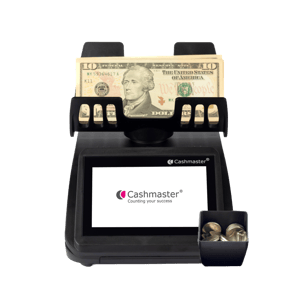
To support greater consistency across its travel retail locations, the customer selected Cashmaster One Max with integrated Printer One.
The solution gave teams a faster, more reliable way to manage floats, till counts, and deposit preparation across different site formats. Its compact, portable design made it practical across the estate, while count-by-weight technology provided a more dependable alternative to older mechanical devices.
Software was configured to align with the customer’s operating procedures, helping standardise routines and improve process control. Each count could be traced to the airport, unit, and cashier, making discrepancies easier to identify and resolve.
With integrated report printing strengthening record keeping and accountability, the business moved to a clearer, more controlled approach to daily cash handling.

The Outcome
The improvement was immediate. The business saved almost five hours per store each week, while the more consistent counting process reduced the time spent on routine handovers and daily cash tasks.
Discrepancies were reduced, and when shortages did need to be investigated the audit trail made the process far quicker. Stronger process control also helped improve cash shrink across the operation.
The commercial return was rapid, with ROI achieved in just five weeks. Staff were also able to spend less time on repeated counting tasks and more time on the day-to-day running of the outlet.
Faster Handovers
Clearer Traceability
Lower Shrink
What This Means for Retailers Like You
If shift changes are slowing the day, cash handling is usually part of the problem. Time spent balancing drawers, checking counts, and chasing discrepancies soon adds up across busy sites.
A clearer counting process helps take that pressure out of the routine. It makes handovers easier, cuts down time spent resolving errors, and gives teams more time to focus on the outlet.
Resources