What Businesses Should Know About the New 10 Dollar Bill

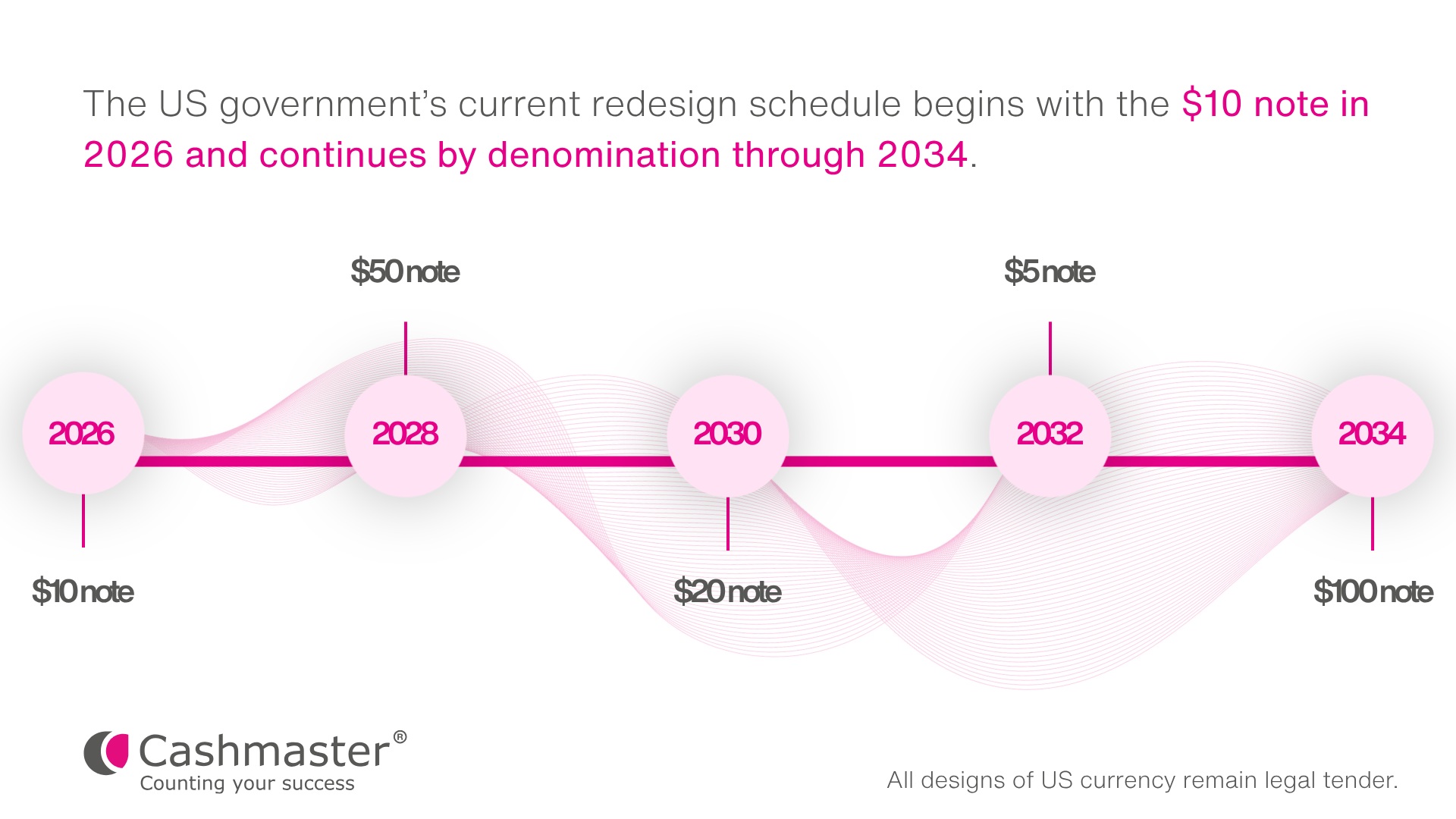
The next redesign cycle for US currency is moving from long-range planning into a more immediate commercial reality, and the first denomination in that sequence is the $10 bill. The official US currency redesign schedule still places the new $10 in 2026, ahead of the $50 in 2028, the $20 in 2030, the $5 in 2032 and the $100 in 2034. Treasury and the Federal Reserve are already allocating production capacity around that programme, which makes this far more than a distant design update.
For businesses that handle cash every day, that matters because a new bill does not simply change what staff see at the register. It affects how notes are authenticated, how equipment reads them, how exceptions are handled, and how confidently teams can manage a period in which old and new versions circulate together. That is where the real operational impact tends to sit.
What is changing and what is still not public
At this stage, the most important point is that the redesign is official, but the full public visual detail is still limited. The Bureau of Engraving and Printing says note designs are typically made public only six to eight months ahead of issuance for public education and cash-handler education, and that releasing concepts earlier would risk aiding counterfeiters and creating confusion in the marketplace. In other words, the industry knows the redesign is coming, but the government does not release every design detail early in the process.
What officials have made clear is the direction of travel. The BEP says the primary purpose of redesign is security, with new notes needing to resist increasingly sophisticated counterfeit threats while still working reliably in commerce. Treasury budget documents for FY 2026 also confirm that the next family of banknotes will include new security features and a raised tactile feature intended to provide meaningful access for blind and visually impaired users. Separate BEP status reports state that the raised tactile feature on the Catalyst $10 has been completed and remains on schedule for production in 2026.
That is an important point for businesses to understand. This is not a redesign for appearance alone. It combines counterfeit deterrence, machine recognition and accessibility in the same piece of currency, which means its effect will be felt across people, processes and equipment.
Why this matters for cash handling operations
New note introductions are often discussed as public education moments, but for cash-handling businesses they are really process moments. BEP says there are more than 10 million banknote machines worldwide that process US currency, and that the final step before full-scale production and issuance is machine readiness, so redesigned notes are accepted and function properly in commerce. It also runs a formal test-deck programme to help approved manufacturers prepare their equipment for upcoming changes to notes in circulation.
That official emphasis on machine readiness mirrors what many businesses will experience locally. When a redesigned bill enters circulation, the first visible issues are rarely dramatic. More often, they show up as friction. A note is rejected unexpectedly. A cashier loses confidence. A manual override becomes more common than it should be. A cash office sees inconsistency between devices and starts spending more time on exceptions. None of those issues begin with the note itself. They begin when the operation around the note is not fully prepared.
This is where the redesign becomes relevant beyond banking and currency policy. For retailers, hospitality operators, financial institutions and any organization managing cash at scale, the new $10 raises a practical question. Are the systems and routines already in place robust enough to handle the transition smoothly, or will the operation only discover its weak points once the bill is already in circulation?
What businesses should focus on now


The mixed circulation period will matter just as much as the redesign itself
One of the most overlooked aspects of any note rollout is coexistence. BEP states clearly that all designs of US currency remain legal tender regardless of when they were issued. That means the arrival of a redesigned $10 will not create a clean handover from old bill to new bill. Businesses should expect a mixed-currency environment in which multiple valid versions of the same denomination circulate side by side for an extended period.
That matters operationally because mixed circulation increases the number of points where uncertainty can creep in. Staff may see unfamiliar design differences while still being expected to keep queues moving. Cash offices may handle both versions in the same reconciliation cycle. Devices across different sites may not respond identically if estates vary in age, maintenance history or update pathway. Even when every note involved is genuine, inconsistency alone can create delays, balancing discrepancies and avoidable uncertainty.
The businesses that manage this period best are usually not the ones that react most dramatically. They are the ones that have already reviewed their equipment estate, understood their support arrangements, briefed front-line teams and made clear what should happen if a note is rejected or flagged.
How the $10 redesign is already affecting businesses
One of the clearest issues emerging locally is low awareness. Many businesses still do not realize that the $10 bill is first in the next redesign cycle, which means preparation may begin later than it should.
There is also a practical concern around older cash-handling equipment. Where validators, counters and detectors rely on more limited sensing capability, static authentication logic or restricted update options, businesses may be more exposed than they expect when the new bill enters circulation. That is why the redesign should be viewed as more than a visual change. It is also an authentication and process challenge.
That will not be true across every operation, however. For businesses already using Cashmaster solutions, including G+D ProNote, the position is more reassuring, with systems already equipped to handle the new notes as they enter circulation.
Comment from our Product Specialist
“During a visit to the Federal Reserve last year, I had the opportunity to review early prototypes of the redesigned $10 bill. What stood out to me was that the conversation is moving beyond appearance alone. Accessibility is becoming a more visible part of banknote development, alongside the machine-readable and security features the market would naturally expect.”
Why this is the right time to review readiness
The current public schedule still points to the redesigned $10 in 2026, and the Federal Reserve’s 2026 print order includes a planned range of 102.4 million to 563.2 million $10 notes. That alone shows this is no longer an abstract future issue. It is part of an active production and rollout cycle.
That does not mean businesses should overreact. It does mean they should use the lead time sensibly. The smartest questions right now are practical ones. Which devices are in the field, and how old are they. What update or support pathway exists for them. How should store teams respond if a genuine note is rejected. Who owns escalation if the same issue appears across multiple sites. How will mixed circulation be explained internally so teams do not confuse a new design with a suspect bill.
Those are not dramatic questions, but they are the ones that separate a controlled transition from an unnecessarily messy one. Currency redesign tends to expose the quality of a business’s cash processes. Where equipment visibility is strong, support is clear and staff know what to do, the impact is manageable. Where those things are weak, even a routine change in the cash cycle can create more disruption than it should.
What this means for businesses now
The new $10 bill is an important currency story, but for cash-handling businesses it is also a useful leadership test. It asks whether the operation is built to absorb change calmly, whether devices and processes are understood well enough to manage a mixed-currency environment, and whether preparation happens early enough to prevent avoidable disruption.
That is why this redesign deserves attention now. Not because businesses need to speculate about every visual detail before it is made public, but because the commercial implications are already clear. A new bill is coming, its purpose is rooted in security and accessibility, and the organizations that handle the transition best will be the ones that treat readiness as part of good cash management rather than a last-minute reaction.
.png?width=352&name=US%20Penny%20(1).png)